Pre- and Protohistoric Archaeology and Provincial Roman Archaeology
Stätteberg - A Bronze Age Hillfort
The excavation of the Bronze Age fortification on the Stätteberg, municipality of Oberhausen near Neuburg an der Donau (district of Neuburg-Schrobenhausen, Upper Bavaria), has been conducted since 2019 as a three-week student training excavation each year. In summer 2025, the excavation will be continued in the area of the acropolis/upper citadel under the direction of Professor Dr. Carola Metzner-Nebelsick.
This huge, largely unknown fortification covering a total area of 86 hectares was founded in the middle of the 2nd millennium BC. This makes it one of the largest Bronze Age castle complexes in Bavaria. The highest point of the plateau is surrounded by a separate fortification made of megalithic "cyclopean" stone blocks, which is unique north of the Alps. The "cyclopean" wall, built from large, hewn limestone blocks in the 14th century BC, was completely uncovered during excavations in one section. Similar walls can be found in the Bronze Age castelliere of Istria on the northeastern Adriatic Sea or in the Aegean Sea. Two wall shells, originally just over two meters high and made of solid limestone blocks, were filled with small stones and rammed earth. Massive wooden posts attached to the front and rear facades held this structure together and formed the foundation of a wooden battlement. In a massive inferno at the beginning of the late Bronze Age, this wall was burned down along its entire length. Afterwards, the castle was probably razed after a successful siege and never inhabited again. The site was also special due to the presence of a large sanctuary, a so-called burnt offering site, at the highest point of the mountain, where animal sacrifices were made and cult meals were held for many participants.
Our investigations show that this type of fortification is unique to the Stätteberg and that the large boulders of the wall were broken immediately in front of it. It is the oldest known quarry in Central Europe. Furthermore, our investigations this year have shown that a pre-wall located 25 meters in front of the large fortification was similarly constructed, although it was less powerful. This wall was not destroyed by fire, but systematically dismantled. The results of the excavation at the rear of the wall were also exciting. In addition to pottery shards, animal bones had been deposited there, the remains of meals, but possibly also evidence of sacrifices. Human bones were also found. Whether these are ritual deposits or victims of the siege remains to be clarified.
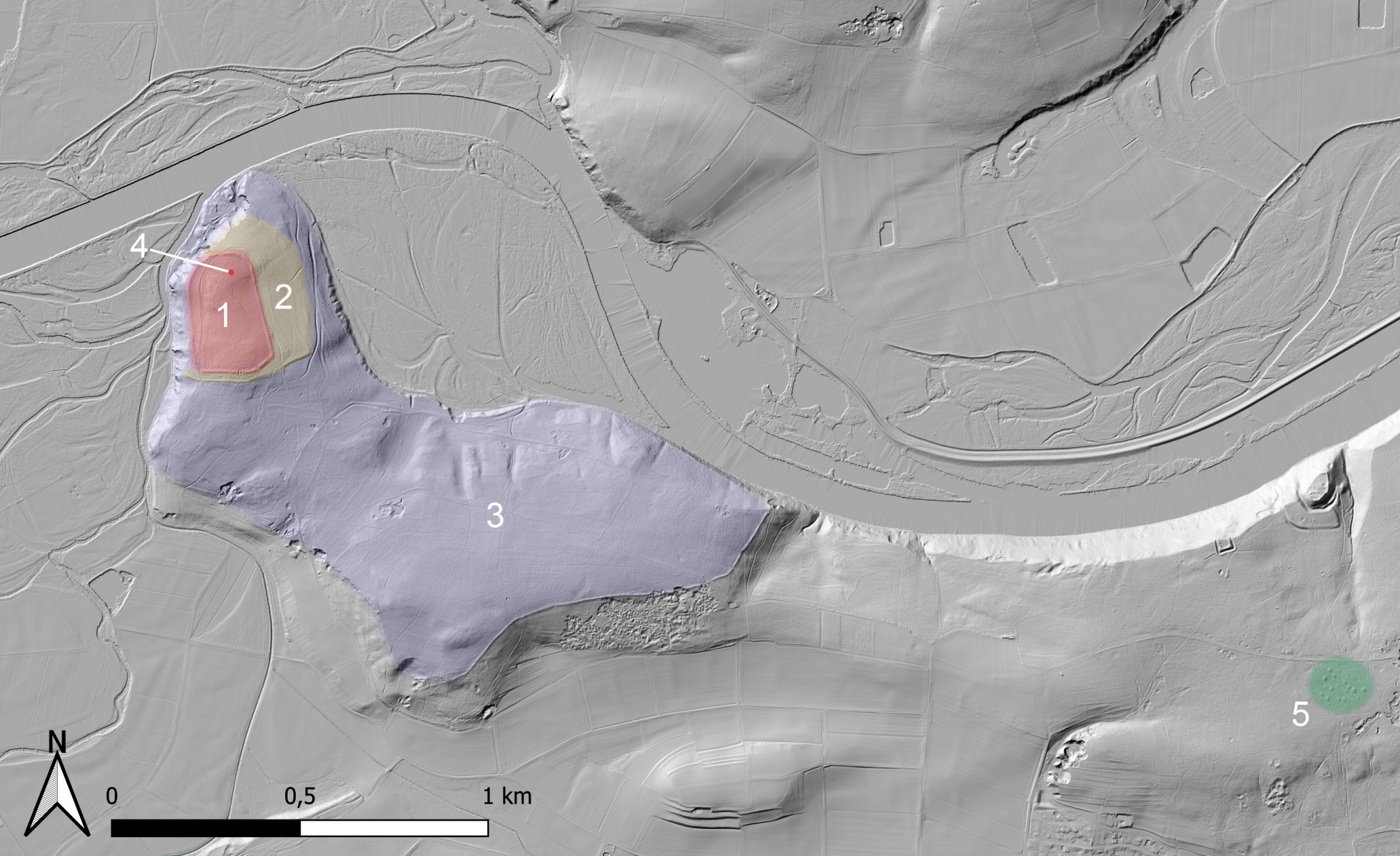
Stätteberg: Digital terrain model of the Stätteberg plateau near Oberhausen with the fortifications colored in and a detailed section of the acropolis. Large image: 1: Area of the acropolis/upper castle from the 14th century BC; 2: Outer fortification, possibly older; 3: Area of the settlement enclosed by an outer rampart; 4: Burnt offering site; 5: Hallstatt period burial ground; 6: Location of the Roman bridge (C. Metzner-Nebelsick/ L. D. Nebelsick/K. Massy/W.-R. Teegen/Th. Simeth, A "cyclopean" stone fortification from the Middle Bronze Age on the Stätteberg near Oberhausen. Das Archäologische Jahr in Bayern 2021, 41-43).
Lehrgrabung der Ludwig-Maximilians-Universität München (Lehrstuhl für Vor- und Frühgeschichte, Institut für Vor- und Frühgeschichtliche Archäologie und Provinzialrömische Archäologie) unter Beteiligung der Kardinal-Stefan-Wyszyński-Universität Warschau (Archäologisches Institut)
Grabungsleitung: Prof. Dr. Carola Metzner Nebelsick (LMU), Prof. Dr. Louis D. Nebelsick (UKSW Warschau)
Grabungsassistenz: Dr. Ken Massy (LMU)
Lehrgrabung 2019; 2021-20245 nächste Grabung: September 2025